
Last Updated: November 8, 2026
Quick Summary
A strategic technology roadmap is a time-phased plan that connects business objectives to specific technology initiatives, with owners, dependencies, and investment levels defined for each. For mid-market firms, it typically runs three years, with detailed plans for the first twelve months and directional plans for years two and three.
- Score every initiative on business value, risk reduction, and dependency, then sequence by combined score.
- Group roadmap spend into run, risk, and growth costs and present them separately to executives.
- Estimate total cost of ownership across the full horizon, including exit costs most business cases omit.
- Cybersecurity belongs on the roadmap as a standing workstream with an owner and measurable target.
- Put AI adoption on the roadmap with use-case inventory, data readiness, approval workflow, and human review.
Table of Contents
- Why Mid-Market Companies Outgrow Their Technology Plans
- What a Strategic Technology Roadmap Actually Is
- Start With a Current State Assessment and Gap Analysis
- Aligning Technology Investments With Business Goals
- A Technology Investment Prioritization Framework That Survives Budget Season
- The Technology Roadmap Timeline and Planning Horizon
- Building the Business Case and Investment Model
- Technology Roadmap Examples for Mid-Market Companies
- A Strategic Technology Roadmap Template for Mid-Market Businesses
- Governance, Cybersecurity, and AI Adoption on the Roadmap
- Frequently Asked Questions
Why Mid-Market Companies Outgrow Their Technology Plans
Most mid-market companies do not fail at technology because they bought the wrong system. They fail because the plan that got them to 200 employees cannot carry them to 500.
The symptoms are familiar. Finance runs one set of reports, operations runs another, and the two never reconcile. A key hire leaves and takes institutional knowledge about a critical workflow with them.
A strategic technology roadmap for mid-market organizations fixes this by replacing reactive purchasing with a deliberate plan tied to business outcomes. Below, we'll show you exactly how to build one, including the prioritization framework and timeline structure that hold up under board scrutiny.
What a Strategic Technology Roadmap Actually Is
A strategic technology roadmap is a time-phased plan that connects business objectives to specific technology initiatives, with owners, dependencies, and investment levels defined for each. It is not a wish list of systems.
The research literature frames roadmapping as a way to represent the relationships among markets, products, and technologies so companies can see those connections clearly, according to research on technology roadmapping. That relational view is the whole point.
For a structured way to organize those pillars, you can explore the Operational Confidence Framework, which maps business alignment, operational excellence, cybersecurity, technology governance, and growth readiness into one model.
How a Roadmap Differs From an IT Strategy and an Annual Budget
An IT strategy states direction. A budget states this year's spending. A roadmap states sequence, dependency, and expected outcome across multiple years. You need all three, but only the roadmap answers the question a CEO actually asks: what do we do first, and what does it buy us?
Start With a Current State Assessment and Gap Analysis
Begin with an honest inventory of what you run today, what it costs, and where it fails the business. The gap analysis compares that current state to a defined desired state, and the distance between them becomes your initiative list.
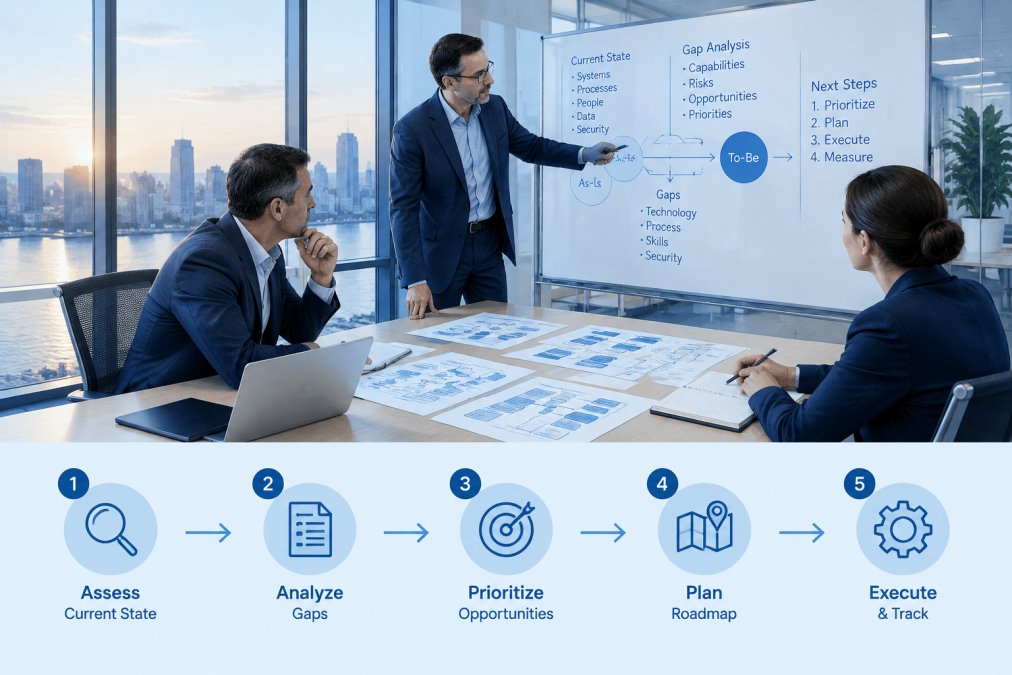
In many mid-market environments, assessments tend to surface the same kinds of findings: overlapping tools performing similar functions, integrations held together by manual workarounds, and unclear ownership of the application portfolio.
That assessment almost always uncovers accumulated technical debt. If that is your finding, our guide on how to reduce tech debt with a 30/60/90-day plan gives you a concrete sequence for working it down without stalling roadmap delivery.
Aligning Technology Investments With Business Goals
Every initiative on the roadmap should trace back to a stated business goal, or it should not be on the roadmap.
Start from the goals themselves. If the objective is to open two new locations, the roadmap must address network scalability, point-of-sale integration, and hiring workflows.
Executives often ask how to keep this alignment from eroding once the plan is approved. The answer is a quarterly review in which each initiative is re-scored against current business priorities. Priorities shift.
For a broader treatment of how alignment translates into organizational confidence, read our practical guide to operational confidence for mid-market firms.
A Technology Investment Prioritization Framework That Survives Budget Season
Score every initiative on business value, risk reduction, and dependency, then sequence by combined score. This simple framework holds up because it forces the conversation onto criteria instead of the loudest advocate in the room.
Use a five-point scale for each dimension and weight them to match your strategy. A company under cyber pressure weights risk higher. A company chasing growth weights value higher.
Scoring Initiatives on Value, Risk, and Dependency
- Business value (1-5): Revenue impact, cost reduction, or capacity gained, with the expected outcome stated in measurable terms.
- Risk reduction (1-5): Exposure removed, whether cyber, operational, or compliance related.
- Dependency (1-5): How many other initiatives depend on this one. High-dependency items move earlier even when their standalone value is modest.
- Effort and disruption (1-5, inverse scored): Implementation cost, internal capacity required, and operational disruption during rollout.
Multiply each score by its weight, sum the results, and rank. Then apply one override: anything that creates a security or continuity exposure the business cannot tolerate moves to the front regardless of score. A repeatable scoring rubric beats a debate every time, and it gives you a defensible answer when the board asks why one project was funded over another.
| Initiative | Value | Risk Reduction | Dependency | Effort | Priority |
|---|---|---|---|---|---|
| Identity and access overhaul | 3 | 5 | 4 | 3 | High |
| ERP integration layer | 5 | 3 | 5 | 5 | High |
| Reporting consolidation | 4 | 2 | 2 | 2 | Medium |
| Legacy server retirement | 2 | 4 | 3 | 3 | Medium |
Value
The Technology Roadmap Timeline and Planning Horizon
A mid-market technology roadmap timeline typically runs three years, with detailed plans for the first twelve months and directional plans for years two and three. That horizon matches most mid-market capital cycles while staying short enough to remain credible.
Structure it in three layers:
- Year one: Fully scoped initiatives with owners, budgets, and implementation milestones. This is your execution plan.
- Years two and three: Sequenced initiatives with estimated investment ranges and defined dependencies, reviewed and refined each year.
- Annual planning refresh: A formal reassessment that rolls the horizon forward and re-scores everything against current business goals.
Quarterly reviews keep the plan honest between annual cycles. Without them, a three-year roadmap becomes a document nobody opens after month four.
Building the Business Case and Investment Model
Group your roadmap spend into three buckets and present them separately: run costs to keep current systems operating, risk costs to close exposures, and growth costs to build new capability. Executives approve these differently, and lumping them together obscures the decision. A board will fund a continuity fix on different reasoning than it funds a new analytics platform, and the business case should reflect that.
The harder discipline is comparing initiatives on a consistent basis. Most mid-market firms evaluate proposals in isolation, which means the project with the most enthusiastic sponsor wins rather than the one with the best economics. Build a simple investment model that every initiative must complete, and apply it uniformly.
A Consistent Total Cost of Ownership Model
For each initiative, estimate total cost of ownership across the full planning horizon, not just the first year. Include:
- One-time costs: licensing or subscription setup, implementation services, internal staff time diverted from other work, and data migration.
- Recurring costs: subscription fees, support, hosting, and the internal labor to administer the system.
- Transition costs: parallel running during cutover, temporary productivity loss, and training.
- Exit costs: what it would take to leave the platform later, including data extraction and contract termination terms.
That last category is the one most business cases omit, and it is the one that determines long-term leverage. A platform that is cheap to enter and expensive to leave is a different decision than one with balanced terms, even when the first-year numbers look identical.
Estimating Benefits in Business Terms
State benefits in the language of the business, with a measurement method attached. Common patterns:
- Labor capacity: if a workflow consumes a defined number of staff hours per week, quantify the hours and show the projected reduction. Convert to dollars only when you can defend the assumption, and be explicit about whether the hours are eliminated or redeployed.
- Risk exposure: describe the exposure in business terms, such as downtime hours per year, recovery time, or the scope of data at risk, rather than technical severity scores.
- Revenue enablement: if the initiative supports a growth goal, tie the benefit to the specific constraint it removes, such as order throughput or onboarding time.
Payback and Funding Trade-Offs
With costs and benefits defined, compute a simple payback period for each initiative: the time until cumulative benefits equal cumulative costs.
Then rank initiatives by payback within each of the three buckets. This produces a defensible funding sequence. When capital is constrained, you fund the shortest-payback risk items first, then the shortest-payback growth items, and you defer the rest with a stated trigger for revisiting them.
Watch out: a business case that assumes full benefits in month one is unlikely to survive its first quarterly review. Phase the benefit curve to match adoption, and hold a portion of the projected value as contingency.
Roadmap approval often stalls on the question of return. Our guide on measuring ROI on executive consulting offers a practical model for valuing advisory investment alongside the technology spend it directs.
Technology Roadmap Examples for Mid-Market Companies
Two patterns show how this works in practice. A consumer goods company engaged an analytics firm to assess its needs, developed a strategic roadmap, and established an analytics center of excellence as the organizing structure for delivery, according to the Elder Research case study, which illustrates how a roadmap plus an ownership model beats a roadmap alone.
The second pattern comes from the energy sector, where a published roadmap development framework documents a wholesale electric utility applying roadmapping to coordinate long-lived infrastructure decisions. The lesson for mid-market firms is that the roadmap's value scales with how many downstream decisions depend on it.
Roadmap priorities also shift by industry. If you want to see how this work applies to your own sector, review the industry context and executive advisory approach behind this kind of engagement.
A Strategic Technology Roadmap Template for Mid-Market Businesses
Use this template as the working structure for your own roadmap. It fits on a few pages and forces the discipline that longer documents lose.
- Business objectives: Three to five goals for the planning horizon, stated in measurable terms.
- Current state summary: Systems inventory, annual run cost, integration map, and known gaps.
- Desired state: What the technology environment must support at the end of the horizon.
- Initiative register: Each initiative with owner, business goal served, priority score, dependencies, and estimated investment range.
- Timeline: Initiatives placed across the three-year horizon, with year one fully detailed.
- Governance: Who reviews the roadmap, how often, and what triggers an out-of-cycle revision.
- Metrics: The KPIs each initiative will move, with baselines and targets defined before work starts.
- Risk register: Cybersecurity, continuity, and vendor risks with mitigation owners.
A strategic technology roadmap template for mid-market businesses earns its keep only if it is short enough to be maintained. Keep the register current and let the narrative sections stay brief.
Governance, Cybersecurity, and AI Adoption on the Roadmap
Governance is what keeps the roadmap alive after the kickoff meeting. Assign a single accountable owner, set a quarterly review cadence, and require every initiative to report against its stated metric. Visibility and ownership are what turn a plan into disciplined spending. Without them, the roadmap becomes a document that describes intentions rather than a tool that directs decisions.
Cybersecurity as a Standing Workstream
Cybersecurity belongs on the roadmap as a standing workstream, not a one-time project. Multi-year items typically include identity and access management, endpoint and backup resilience, vendor risk review, and incident response testing. Each should carry an owner and a measurable target.
The governance question executives should ask is not whether the work is happening, but whether anyone can prove it is working. Define the metric before the initiative starts. For backup resilience, that might be a tested restore time. For identity, it might be the share of accounts covered by multi-factor authentication. A metric defined after the fact tends to describe what was achieved rather than what was needed.
A Pragmatic Approach to AI Adoption
Artificial intelligence deserves the same treatment, and it is where most mid-market governance is weakest. Many firms are experimenting with AI tools well ahead of any policy governing their use.
A workable approach has four parts:
- Use-case inventory. List where AI is already being used or proposed, by function. Rank each by the sensitivity of the data involved and the consequence of a wrong output.
- Data readiness. Determine which data the use case depends on, whether it is accurate and current, and whether it is permitted to leave your environment. Most AI initiatives fail on data quality long before they fail on the model.
- Approval workflow. Define who approves a new AI tool, what information they need, and how vendor terms are assessed, particularly around data use, retention, and training.
- Human review. Specify which outputs require a person to check them before they affect a customer, a payment, or a compliance obligation.
Put AI adoption on the roadmap with these elements as explicit line items, not as an aspiration.
Watch out: an AI policy written by legal alone tends to be either so restrictive that staff route around it or so vague that it changes nothing.
The governance test is simple. If a board member asked next quarter which AI tools are in use, what data they touch, and who approved them, could you answer? If not, that gap belongs on the roadmap.
Frequently Asked Questions
What is a strategic technology roadmap?
It is a written plan that connects technology initiatives to specific business outcomes over a defined period, usually two to three years. It names the current state, the desired state, the gaps between them, and the sequence of projects that close those gaps. Unlike a budget or a wish list, a strategic technology roadmap shows dependencies, owners, and the metrics each initiative is expected to move, so leadership can see why money is being spent and what it should produce.
How long should a technology roadmap cover?
Most mid-market companies get the most value from a three-year horizon. Year one is detailed enough to budget and staff, year two is directional, and year three is a set of themes rather than commitments. That structure matches how capital and headcount actually get approved. Review the full roadmap annually and the near-term quarter every 90 days, because vendor changes, growth, and security events will move priorities faster than a three-year plan can anticipate.
How do you prioritize technology projects when resources are limited?
Score every candidate initiative on four dimensions: business value, risk reduction, cost to execute, and dependency on other work. Rank by value and risk first, then use cost and dependency to decide sequence rather than whether to proceed. This keeps the conversation about outcomes instead of whoever argues loudest. A technology investment prioritization framework also gives you a defensible reason to say no, which matters more than most executives expect when budgets are tight.
What is the difference between an IT strategy and a technology roadmap?
An IT strategy states the principles and direction: what the business needs technology to do, how you will govern it, and what you will and will not invest in. A technology roadmap translates that strategy into dated, sequenced initiatives with owners and success measures. You need both. A strategy without a roadmap rarely gets funded; a roadmap without a strategy becomes a list of projects that each look reasonable and collectively go nowhere.
How often should a technology roadmap be reviewed?
Run a quarterly review of the near-term plan and a full annual refresh of the whole roadmap. The quarterly review checks delivery against milestones, confirms funding, and reorders work if a business priority has shifted. The annual refresh re-validates the current state assessment, the gap analysis, and the three-year sequence. Skipping the quarterly cadence is the most common reason roadmaps quietly die: the document stays accurate on paper while the business moves on without it.
What should a technology roadmap include?
At minimum: a current state assessment, a desired state tied to business goals, a gap analysis, a prioritized and sequenced initiative list, a timeline with milestones, named owners, budget allocation, dependencies, and the KPIs each initiative should move. Add a risk register and a short section on change management and workforce readiness. The last two are what separate a roadmap that gets executed from one that gets admired and shelved.
